BalanceBikeToddler
How to Choose a Balance Bike by Age
Why published age ranges disagree, what our snapshot shows at each year, and how to turn a birthday into an inseam number you can shop with.
By BalanceBikeToddler Editorial Team ·
Short answer: Why published age ranges disagree, what our snapshot shows at each year, and how to turn a birthday into an inseam number you can shop with.
Balance bike listings are sorted by age, but the age on the box is the manufacturer's opinion, not a measurement. This guide covers what the age ranges in this category actually say, where the coverage thins out, and how to turn a birthday into a fit check you can do before you buy.
Why age ranges disagree
Two listings can both say "for 2 year olds" and still fit the same child differently, because the age range is written by the brand from its own seat-height range, while the child is measured in inseam. Age is the label the market searches on; the seat range is what decides the fit. When a listing publishes both, check that the seat range is consistent with its own age span. When it publishes only the age, you are reading a claim with nothing behind it.
What the snapshot says
The figures below are read out of this site's own product specification snapshot — 156 products scanned on 13 October 2026 — and they are the same figures the age-fit reference renders.
- 13 balance bikes are listed in the snapshot.
- 12 of the 13 publish an age range; one publishes none.
- The stated spans run from 10 months to 60 months — a five-year spread across a category most children use for two.
- The published spans cluster hard at the young end: 6 of the 12 say 12–24 months, 3 say 24–60, 2 say 10–36, and 1 says 18–60.
So the category is not one continuous ladder. It is two shelves: a starter shelf that ends at the second birthday, and a second shelf aimed at two-to-five-year-olds.
Coverage by age
Counting how many of those 12 listings still cover the child at each age:
- 1 year — 8 of 12.
- 18 months — 9 of 12.
- 2 years — 12 of 12.
- 2.5 years — 6 of 12.
- 3 years — 6 of 12.
- 3.5 years — 4 of 12.
- 4 years — 4 of 12.
- 5 years — 4 of 12.
Two years old is the best-served age in the category, and the only one every listing covers. After it the pool halves twice: six listings still fit at three, and four at four. If you are shopping for a four-year-old you are choosing among four models, and by then it is worth asking whether a balance bike is the right purchase at all.
The four-wheel cluster
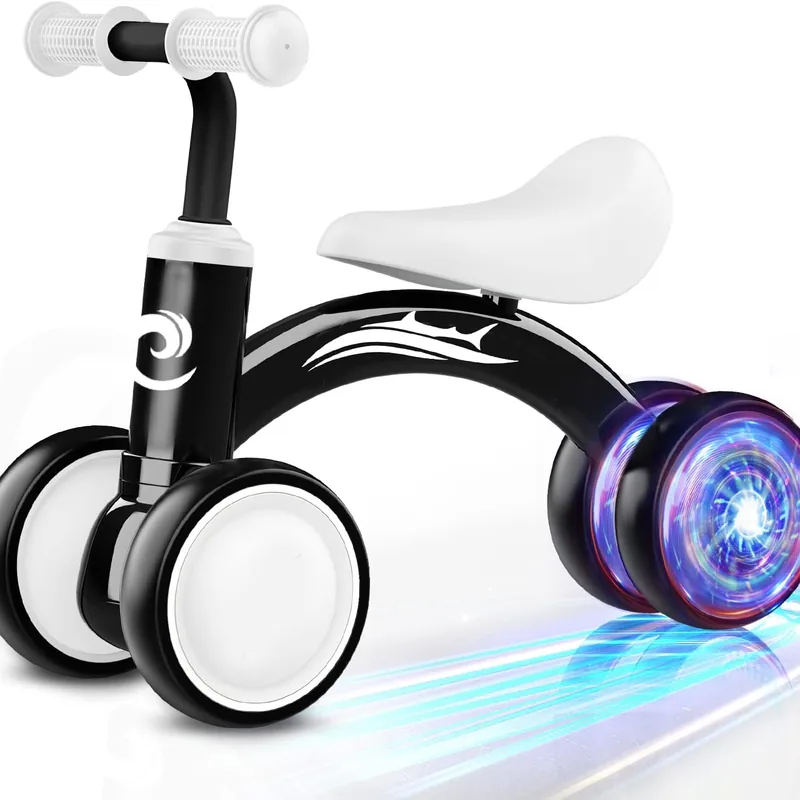
The youngest end of the category looks different from the rest. Of the 13 balance bikes in the snapshot, five are four-wheel models, and every one of them carries a 12–24 month age span — they are the entire young end of the market. A four-wheel layout stands up on its own, which is what the youngest riders need; what it removes is the lean, so the balancing practice happens later. That is a stage, not a defect.
Turning a birthday into a fit number
Age gets you to a shortlist; the inseam gets you to a bike.
- Use the age to pick the shelf. Under two, the 12–24 month cluster; over two, the 24–60 month cluster.
- Measure the inseam and read the seat-height range, not the age. The size chart guide walks through the two-minute measurement.
- Check the top of the seat range, not the bottom. A bike that fits today but tops out at this year's inseam is a one-year purchase.
- Treat a missing age range as a missing answer, not a neutral one. A listing that will not state its span rarely publishes a seat range either.
Age and the rest of the decision
- At one: the starter cluster. Look for the lowest seat position available and accept a short useful life — a 12-month-old grows out of a first bike quickly. The 1-year-old guide covers this age specifically.
- At two: the best-served age, and the point where a wide seat range starts to pay. This is the age to buy for the next two years rather than the next six months.
- At three and beyond: the pool narrows to six, then four, and many children are ready for a pedal bike by then.
- Weight matters more with age. A three-year-old can lift more bike than an 18-month-old can; the weight guide covers what the materials change.
Method and limits
Every age figure here is quoted from the manufacturer's own listing copy — the age field each retailer syncs — and captured in the 13 October 2026 snapshot of 156 products. No age span is measured, averaged, or inferred by us, and where a listing states no age range this page reports none. Spans change when brands revise their copy, so verify against the current listing before buying.
Further reading
- Balance bike by age reference — every listing, by age band.
- Size chart guide — inseam to seat height.
- Stability guide — what the youngest cluster gives up for standing up on its own.
Related Reviews
Products Mentioned in This Guide
- Graco SlimFit3 LX 3-in-1 Convertible Car Seat, Slim Car Seat Fits 3 Across, Rear Facing, Forward Facing, to Highback Booster Seat, Perfect for Baby Travel & Gift for New Parents, KunninghamSource-based score, full specs & safety checklist for the Graco SlimFit3 LX 3-in-1 Convertible Car Seat, Slim Car Seat Fits 3 Across, Rear Facing, Forward Facing, to Highback Booster Seat, Perfect for Baby Travel & Gift for New Parents, Kunningham.
- JOYSTAR 12 14 16 18 Inch Kids Bike for 2-9 Years Girls, Toddler Girls Bike with Training Wheels, Rainbow Bikes, Children BicySource-based score, full specs & safety checklist for the JOYSTAR 12 14 16 18 Inch Kids Bike for 2-9 Years Girls, Toddler Girls Bike with Training Wheels, Rainbow Bikes, Children Bicy.
- Retrospec Cricket Baby Balance Bike, 4-Wheel Ride-On Toy for Ages 12-24 Months – First Bike & Toddler Bike for 1 Year Old Boys & Girls, First Birthday GiftSource-based score, full specs & safety checklist for the Retrospec Cricket Baby Balance Bike, 4-Wheel Ride-On Toy for Ages 12-24 Months – First Bike & Toddler Bike for 1 Year Old Boys & Girls, First Birthday Gift.
Balance bike reference pages
- Balance bike size chartSeat height, wheel diameter and inseam fit, measured per model.
- What buyers sayWhat the buyer-sentiment summaries mention, where they hedge, and what they cannot tell you.
- Which models fit at each ageEach maker's age range, where coverage thins out, and how to turn a birthday into a fit check.
- Stable track balance bikeWheel spacing, steering limiters and the four-wheel trade-off — published by one in thirteen.
- Weight and buildBike weight against child weight, with frame and tire material.
- Safety standards referenceWhat EN 71, ASTM F963 and CPSC actually require of a balance bike.
- Balance bike recall recordCPSC and EU Safety Gate alerts with dates, hazards and remedies.
- Budget & value balance bikeWhat each price tier buys, the frame, tire and weight trade-offs, and the checks that separate a cheap bike worth keeping.
Continue browsing the full guide library.